Nature Journaling
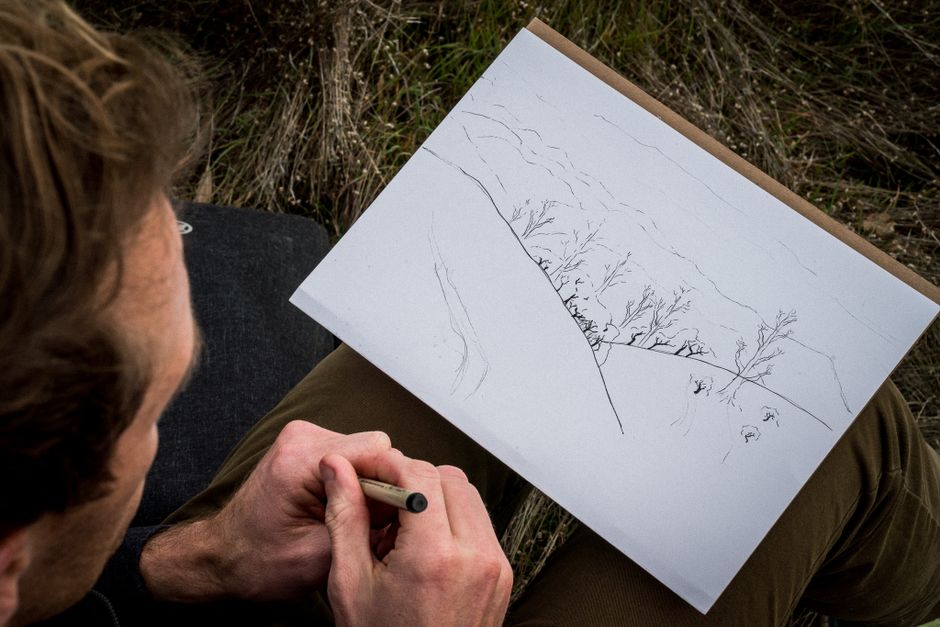
Birds are the hardest and most rewarding subjects in field sketching. They move, they hide, and they seem to know exactly when you have finally gotten the beak right. But you do not need a bird to sit still for ten minutes to sketch it well. You need a different approach, one built around quick marks and patient watching.
Start by watching before you draw. Spend the first minute just observing how the bird moves, where it holds its weight, how it tilts its head. Most beginners start drawing too soon and end up with a stiff outline of a bird that never existed. Let your eye do the work first, then let your pencil catch up.
When you do start, work in loose shapes. A circle for the head, an oval for the body, a triangle for the tail. Do not chase feathers yet. Get the gesture, the energy of the pose, and only then add detail. If the bird flies off, you still have something useful on the page. A rough shape with the right attitude beats a careful outline of a bird that already left.
Field marks are your best friends. Note the eye stripe, the wing bars, the color of the legs, the shape of the bill. Write them in the margin next to your sketch even if you cannot draw them yet. A quick label like "yellow throat, white wing patch" preserves information your sketch might miss. Later, when you look up the species, those notes confirm what you saw.
Memory sketching matters too. After a bird disappears, sit for a moment and draw what you remember without looking at anything. You will be surprised how much stays with you, and how much sharper your observation becomes once you know you will be tested by your own memory. This is a skill that improves fast with practice.
Keep a few pages in your journal for birds you see often. A local species you sketch repeatedly will teach you more than a rare one you glimpse once. The robin on your fence, the sparrow in the hedge, the gull on the pier, these familiar birds become your teachers.
The best bird sketchers are not the fastest. They are the most patient. They return to the same pond at the same hour, they learn where the heron likes to stand, and they wait. Over time, the birds stop treating you as a threat, and you get longer looks.
Bring a small pair of binoculars if you have them. Alternating between binoculars and sketchbook lets you study detail up close and then translate it to paper. It also gives your eyes a rest and helps you see the whole bird rather than just one part.
Do not compare your pages to the polished plates in a field guide. Those took years. Your journal is a record of your own seeing, and every messy sketch is a step toward understanding. The birds will keep moving. Your job is to keep looking, and to trust that the marks will come.
